Parents ask us a very specific version of the desert safari question: will my kids actually enjoy this, or will we spend AED 600 on a stressed toddler and a ruined evening? Having sent thousands of families into the Dubai desert, the honest answer is that most kids love it — but the package you pick, the timing, and a few pre-trip decisions make the difference between a trip highlight and a meltdown at kilometre 30 of dune bashing.
Age considerations that actually matter
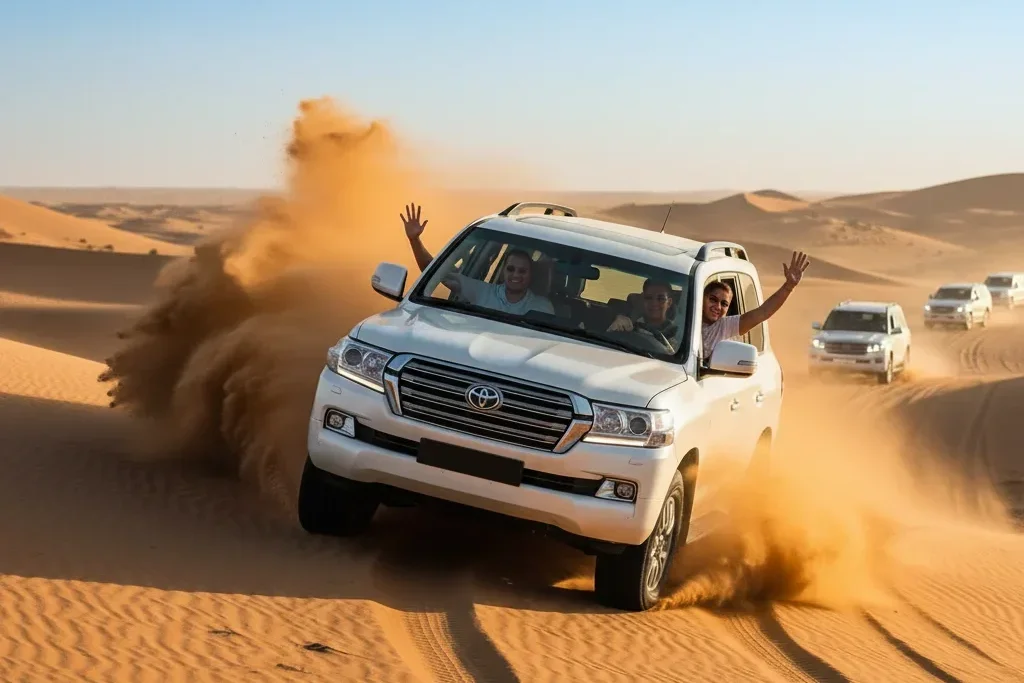
Dune bashing itself has no strict legal age limit in most vehicles, but common sense and most operators' own guidance point to caution under age 3 — the sharp, repeated jolts are hard on infants and toddlers who can't brace themselves, and some operators will ask you to sign a waiver or decline infants outright for safety reasons. From roughly age 4 upward, most kids find dune bashing thrilling rather than scary, provided they're securely seated with a seatbelt (always insist on this — a good driver will too).
Quad biking has a firm legal minimum: solo quad riding requires riders to be at least 8 years old (some operators set it at 10) and above a minimum height, usually around 140cm. Younger children can often ride as a passenger on a double quad behind a parent, but confirm this specific option with the operator before you arrive, since not every camp offers it.
Morning vs evening safari — which suits families better
For families with kids under 6, we generally steer parents toward a morning desert safari over the classic evening one. It runs earlier in the day when kids are naturally more alert, avoids the late 9:30–10:30pm drop-off that wrecks a toddler's bedtime, and skips the loudest, latest parts of the evening entertainment (fire shows can genuinely startle very young children). The trade-off is no BBQ dinner or evening show, but most young families are happy to eat that meal back at the hotel on their own schedule anyway.
For families with kids aged 7+, the evening safari with BBQ dinner tends to be the more memorable choice — older kids enjoy the camel photos, henna, sandboarding and the buzz of the fire and tanoura shows, and can comfortably handle the later bedtime once or twice on a holiday. Our evening-desert-safaribudget-friendly package is a reliable, well-tested pick for this age group.
Regular vs red dune safari for families
Stick with a regular (not red dune) desert safari for families with children under 8 or anyone prone to motion sickness — the gentler dunes and shorter drive make a meaningful difference to how the car ride feels for a young child. Red dune safaris' steeper, more aggressive dune bashing is genuinely better suited to families with teenagers or confident older kids who'll treat it as the highlight of the trip rather than a scary car ride.
What's actually fun for kids at camp (and what isn't)
Camel photo stops, sandboarding, and henna painting are consistently the biggest hits with kids of all ages — free, low-risk, and genuinely novel for most children visiting from outside the region. Falconry photo opportunities are popular with kids 6+ who aren't scared of birds up close (some are — ask before pushing a shy child toward one). Shisha lounges and the belly dance show are adult-oriented and not particularly engaging for young kids, so don't feel obligated to sit through the full show if bedtime is looming.
- Sandboarding: free, unlimited, hit with almost every age
- Camel photo stop: great for all ages, best photos of the trip for many families
- Henna painting: popular with kids 5+, especially girls
- Falconry photos: fun for confident kids 6+, check comfort level first
- Quad biking: 8+ solo (height restriction ~140cm), some camps offer double-rider option for younger kids
- Fire/tanoura show: can be loud and late for toddlers — fine for kids 6+
Packing and practical tips for families
Bring a light jacket even in summer — camp air conditioning in tents and the evening desert breeze after sunset both get surprisingly cool. Pack wet wipes and a change of shoes; sand gets everywhere, including inside closed sneakers, and kids will want to run around. If your child has specific dietary needs, mention it at booking — most BBQ buffets include grilled chicken, rice, salads and bread that work for picky eaters, but confirm ahead if there's an allergy involved rather than hoping the buffet works out.
Bring your own car seat or booster if your child normally needs one for road travel — most desert safari vehicles do not carry child car seats as standard equipment, and while the on-road drive is a normal paved highway for the first stretch, UAE law still expects appropriate restraint for young children on that portion of the journey.
Our actual recommendation for families
For a family with kids under 6: book a morning safari, regular (not red) dunes, private vehicle if your group is 4+. For a family with kids 7–12: evening safari with BBQ dinner, regular dunes unless your kids are confirmed thrill-seekers, shared is fine if budget matters. For families with teenagers: red dune evening safari with quad biking add-on tends to be the trip highlight everyone still talks about. Whatever the mix, book through /trip-type/desert-safari and flag ages at checkout so pickup and activity planning account for your group properly, or reach out via /custom-trip if you want us to build the exact combination around your family's ages and pace.
A real case: a flight delay and a same-day booking
A guest's inbound flight was delayed by six hours, landing her in Dubai at 6pm instead of noon, well after her booked 3pm desert safari pickup. Because she messaged us the moment her flight delay was confirmed, rather than after missing the pickup entirely, we were able to move her booking to the following evening at no charge, since it was flagged well before the no-show cutoff and clearly outside her control.
Had she waited until after the missed pickup to contact us, the booking would have been treated as a no-show and been non-refundable under standard policy — the difference between a free reschedule and a forfeited booking, in this case, came down entirely to a five-minute WhatsApp message sent proactively rather than reactively.
Should you buy travel insurance specifically for this?
For most travellers, the standard 24-48 hour free cancellation window already covers the realistic scenarios — illness, schedule changes, minor delays — without needing separate insurance. Where insurance genuinely adds value is around non-refundable no-show scenarios caused by things outside your control that happen inside the cancellation cutoff, such as a sudden flight cancellation the same day, since standard operator policy won't refund a no-show regardless of the cause.
If you're booking a premium private or overnight safari (AED 1,000+) during a trip with tight connections or a packed schedule, the relatively small cost of travel insurance is a reasonable hedge against losing that amount entirely to an unavoidable no-show.
How to compare cancellation policies before you pay
Not every operator publishes their cancellation terms clearly, and this is worth checking before booking, not after something goes wrong. Look specifically for the exact cutoff (in hours, not vague terms like 'in advance'), whether partial refunds exist inside that window, and what happens for operator-side weather cancellations — a transparent operator will spell out all three without you having to ask.
If a listing's cancellation terms are vague or buried, that's a reasonable signal to book elsewhere or at least message the operator directly to get the policy in writing before paying, especially for higher-value private or overnight packages where the amount at risk is larger.
A real case: balancing a toddler and a teenager on the same trip
A family travelling with a 2-year-old and a 15-year-old asked us whether a single safari booking could work for both, or whether they'd need to split into two separate trips. We booked a private evening safari on standard dunes, arranged a gentle dune-bashing pace for the toddler's comfort, and pre-booked the teenager into a solo quad biking session at camp so she had her own thrill activity while her parents managed her younger sibling nearby.
It worked well specifically because private transport let them opt out of the loudest, latest part of the fire show once the toddler got overtired around 8:30pm, heading back to the vehicle early without disrupting anyone else's evening — something that isn't really possible on a shared shuttle running to a fixed group schedule.
Best time of year to book a family desert safari
November through March offers the most forgiving conditions for families — evening temperatures of 18-26°C mean kids can run around at camp comfortably without overheating or needing constant sunscreen reapplication before dark. This window also lines up with UAE and many international school holidays, so camps run fuller and it's worth booking 3-5 days ahead rather than the day before.
June through August is genuinely tougher on young kids given daytime heat exceeding 40°C, though a morning safari timed for sunrise (around 6am pickup) sidesteps the worst of the heat and often has noticeably smaller crowds than the equivalent winter booking, since fewer families travel to Dubai in peak summer.
Planning a realistic family desert safari budget
Beyond the base ticket price, budget an extra AED 150-300 per family for quad biking if older kids want it, AED 50-100 for printed or digital photos if you don't want to rely on phone cameras in low camp lighting, and a buffer for tipping (AED 20-50 per family for the driver and camp staff is customary and appreciated). A realistic all-in budget for a family of four doing a shared evening safari with a few extras sits around AED 700-900 total, while the same family going private with quad biking for the older kids lands closer to AED 1,200-1,400.
None of this needs to be spent to have a good evening — the base package alone genuinely satisfies most families — but going in with realistic numbers avoids the slightly deflating experience of being asked to pay for six different upsells once you're already at camp and can't easily say no in front of excited kids.
Tours mentioned in this guide
Frequently asked questions
How much does a family desert safari cost in Dubai?+
Prices for Best Desert Safari Dubai Packages For Families range from AED 89–400 per adult depending on the package. Popular add-ons: Quad Biking AED 75, Dune Buggy AED 500, Falcon Photo AED 10, VIP Camp Seating AED 50. Child pricing and hotel pickup are shown on each tour page.
What is the minimum age for desert safari in Dubai?+
There is no strict legal minimum for dune bashing itself, but most operators and our own guidance recommend caution under age 3; quad biking solo requires riders to be at least 8 years old with a minimum height around 140cm.
Is morning or evening desert safari better for kids?+
Morning safari suits children under 6 best due to earlier timing and no late drop-off; evening safari with BBQ dinner suits kids aged 7 and up who can enjoy the fuller entertainment programme.
Can toddlers do dune bashing?+
Some operators allow it with a seatbelt and parental discretion, but the repeated jolts are genuinely hard on very young children, so many families with toddlers choose a gentler regular (non-red-dune) route or skip dune bashing in favour of the camp activities only.
Do desert safari camps have car seats for kids?+
No, standard desert safari vehicles do not carry child car seats — bring your own booster or car seat if your child normally requires one.
Is private or shared safari better for families?+
Private is generally better for families with young children since it removes the pressure of a fixed group schedule, and the per-person cost becomes reasonable once split across 4 or more family members.
What activities at the camp are best for kids?+
Sandboarding, camel photo stops and henna painting are consistently the most popular with children of all ages; quad biking requires kids to be 8+ and meet a height minimum.
Should we book red dune or regular safari for kids?+
Regular safari is the safer, more comfortable choice for children under 8 or anyone prone to motion sickness; red dune suits confident older kids and teenagers who want a bigger thrill.